
Fountain County Court Records After Arrest
After a Fountain County arrest, the jail record and the court record are not the same file. The jail record follows booking, custody, release, holds, and sometimes the arresting agency. The court record follows the criminal case after the Fountain County Prosecutor files charges. That court file can show the cause number, case type, filed counts, hearing dates, bond orders, no-contact orders, warrants, plea entries, trial settings, dismissals, and sentencing entries.
The custody side is handled through the Fountain County Jail and the INjail Public Access portal. The court side is handled through Indiana's public court search and local court offices. Use Fountain County jail inmate records for booking and custody checks, and use Fountain County jail mugshots for booking-photo questions. Court records after a jail arrest should be read as filed criminal case records, not as a promise that the original booking charge was proven.
Fountain County uses prosecutors, not district attorneys. The Fountain County Prosecutor's Office is led by Daniel L. Askren and prosecutes traffic infractions, juvenile delinquency cases, and adult criminal offenses. The prosecutor's office is at the county courthouse in Covington, while jail custody and bond posting are handled at the sheriff and jail campus in Veedersburg.
Find Fountain County Court Records
Indiana's official public court search is MyCase. For court records after a Fountain County jail arrest, start with the person's legal name, the arrest date, or a cause number if INjail, SAVIN, a notice, or a clerk document gives one. Filter to Fountain County or Fountain Circuit Court when the current interface allows it. Public non-confidential cases may show a chronological case summary and, in some cases, linked documents.
- Open MyCase and search by defendant name or exact case number.
- Use Fountain County, case type, or filed-date filters to narrow a common name.
- Open the criminal case and read the filed charges, not just the case caption.
- Check each docket entry for bond, warrant, plea, dismissal, amendment, or sentencing action.
- Contact the clerk when a public document is not linked online.
The Indiana Judicial Branch MyCase help page says some public documents are online at no cost, but some are not online and older case availability can vary. Official court records must come from the court that keeps the file. For Fountain County, the Clerk of Courts handles record-keeping for criminal and civil judgments and case filings.
The Indiana Judicial Branch Fountain County page links to MyCase and local court information.
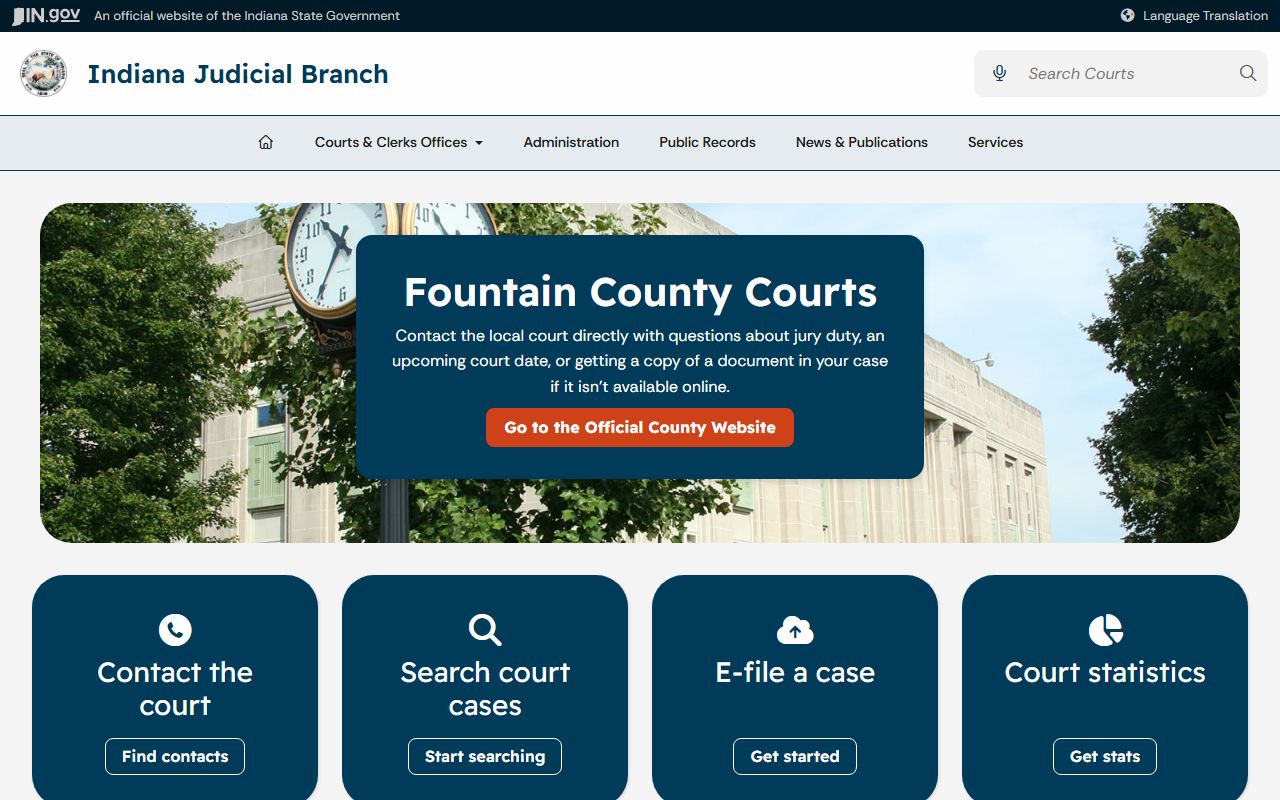
That court page is the local bridge between the statewide court search and the Fountain County offices that maintain the official case file.
Fountain County Court Search Fields
MyCase fields can change as the state updates the interface, but Fountain County court records after an arrest are usually found through the same core data points: a case or citation number, a party name, court filters, case type, and filing dates. If the person is newly booked and no court case appears yet, the prosecutor may not have filed the case, or the public case may be limited by rule.
| Field | Use | Notes for Fountain County |
|---|---|---|
| Case number or citation number | Best match when known | Use the exact cause number from a notice, SAVIN, or court document. |
| Party name | Searches the defendant's name | Add middle name or date filters if the name is common. |
| Court or county | Narrows by location | Choose Fountain County or Fountain Circuit Court when available. |
| Case type | Separates criminal, infraction, ordinance, and civil matters | A jail arrest is usually tied to a criminal, infraction, or related warrant case. |
| Filed date range | Narrows new cases | Use dates after the arrest if the case is recent. |
Arrest to Fountain County Charges
The path from arrest to court record is practical and local. A person may be arrested by the sheriff, Indiana State Police, Attica Police, Covington Police, Veedersburg Police, or another agency. Booking at Fountain County Jail creates the custody record. The prosecutor then reviews the allegation and files, amends, reduces, or declines charges. Once a case is filed, the court record becomes the better place to track the formal charge list and case status.
Different documents can start or support the case. A complaint is an initial written allegation or charging paper. An information is a prosecutor-filed charging document used in many Indiana cases. An indictment is a grand-jury charge and is less common in routine local cases. These terms matter because the jail roster may show one arrest label, while the court case may show a different filed count after review.
| Document | Who Uses It | What It Does |
|---|---|---|
| Complaint | Officer or prosecutor | States the allegation and can begin the criminal case. |
| Information | Prosecutor | Lists the formal charges the prosecutor files in court. |
| Indictment | Grand jury | Charges an offense after grand-jury action. |
Process flow: Arrest, booking, first court review, prosecutor charging decision, court case, hearings, disposition.
Fountain County Charge Status
Fountain County court records after a jail arrest may change more than once. A count can be pending at filing, amended after review, reduced through plea negotiation, dismissed by court order, or resolved by conviction. A dismissed charge is not the same thing as a conviction. A pending charge is not proof of guilt. Read the most recent docket entries and the final disposition line before drawing conclusions.
| Status | Plain Meaning | Record Caution |
|---|---|---|
| Pending | The charge is filed but not resolved. | Check for later plea, trial, dismissal, or amendment entries. |
| Amended | The prosecutor changed the wording, count, or charge level. | Compare old and new counts before citing the charge. |
| Reduced | The charge was lowered by amendment or plea. | The final conviction, if any, may be different from the arrest label. |
| Dismissed | The charge ended without conviction on that count. | Other counts in the same case may still remain. |
| Nolle prosequi | The prosecutor declined or dismissed prosecution. | Review whether the entry applies to one count or the whole case. |
The Indiana MyCase public search interface is the source shown for filed charge and case-status searches.
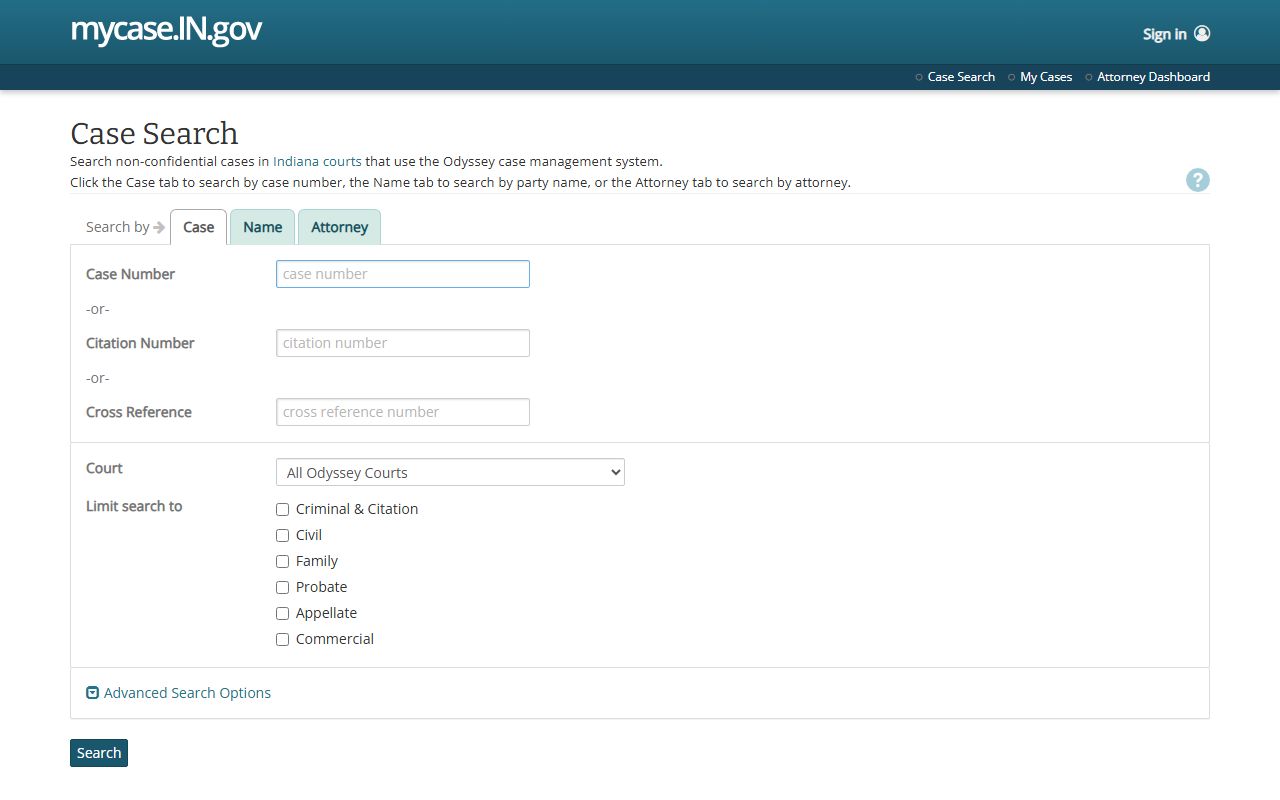
The MyCase search screen is useful when the booking name is known but the exact cause number is not.
Bond Orders and Warrants
Bond and warrant entries can appear in both jail and court workflows, but they mean different things depending on the source. Fountain County's jail bond page says bonds can be posted at the jail with exact cash or by debit or credit card through GovPayNow in person at the jail. It also says cash bonds are paid at the Release 2 Door and that bond posting is available 24 hours a day, 7 days a week. The court record, by contrast, shows the judge's bond order, conditions, no-contact orders, and later changes.
No official Fountain County sheriff criminal warrant search page was located in the research. If a person is arrested on a warrant, INjail may show a booking after custody begins, and MyCase may show docket entries such as warrant issued, warrant recalled, failure to appear, bond forfeiture, or body attachment when the case is public. Some warrants require court action before release even if money is paid on a separate case.
| Bond or Hold | How It Works |
|---|---|
| Exact cash bond | Paid in person at Fountain County Jail when allowed by the court order. |
| Card bond | Paid through GovPayNow at the jail, with the county-published nonrefundable service fee. |
| PR release | Release by court order on a promise and conditions, with no upfront cash. |
| No-bond hold | Custody continues until court or agency action authorizes release. |
| Detainer | Another agency or jurisdiction asks the jail to hold the person. |
Charges and Convictions Compared
A Fountain County arrest, a filed charge, and a conviction are three different points in the case. The arrest starts the custody and investigation path. The charge is the formal accusation filed in court. A conviction exists only after a plea or finding of guilt. That difference is vital when reading public court records after a jail arrest.
| Point in Case | Charge | Conviction |
|---|---|---|
| Meaning | Formal accusation filed in court. | Guilt finding or plea accepted by court. |
| Timing | After prosecutor filing and before final disposition. | After plea, bench trial, or jury trial result. |
| Proof level | Based on probable cause and charging review. | Requires proof beyond a reasonable doubt or a valid plea. |
| Public use | Should be described as alleged unless resolved. | Can be described as the case outcome if final. |
The same caution applies to background checks. A casual court lookup is not a substitute for a lawful consumer report, and the footer legal notice limits FCRA-covered use.
Sealed and Expunged Records
Indiana's expungement and restricted-disclosure law sets procedures for limiting public access to qualifying arrest and conviction records. The Indiana Rules on Access to Court Records also control which court records are public and which are confidential. Juvenile matters, sealed cases, protection-order limits, confidential documents, and restricted records may not appear in the same way as ordinary adult criminal cases.
| Access Term | Plain Meaning | Fountain County Record Effect |
|---|---|---|
| Sealed | Hidden from normal public access by rule or order. | MyCase may show limited information or no public detail. |
| Expunged or restricted | Public access is limited after statutory criteria are met. | The person must follow Indiana's court process. |
| Confidential | Protected by law, court rule, or case type. | The clerk may deny public copies or redact records. |
Fountain County Public Access Rules
Indiana's Access to Public Records Act gives the public a right to inspect and copy public agency records unless an exemption applies. IC 5-14-3-3 states the general inspection and copying right. IC 5-14-3-4 lists confidential and discretionary exemptions, including some law-enforcement and investigatory records. Court access is also governed by the Indiana Rules on Access to Court Records.
Use the Fountain County Clerk when a public court document is not available online. Use the sheriff's office for jail booking records, custody records, or records not shown in INjail. Use Indiana SAVIN or VINELink for custody notifications, IDOC for sentenced state prisoners, and BOP or ICE systems for federal or immigration custody. Those channels answer different questions, so a missing record in one system does not prove that no case or custody status exists.
Important: Public court searches can be incomplete, delayed, sealed, or misread; verify official records with the clerk, court, or sheriff.